The collector’s perspective
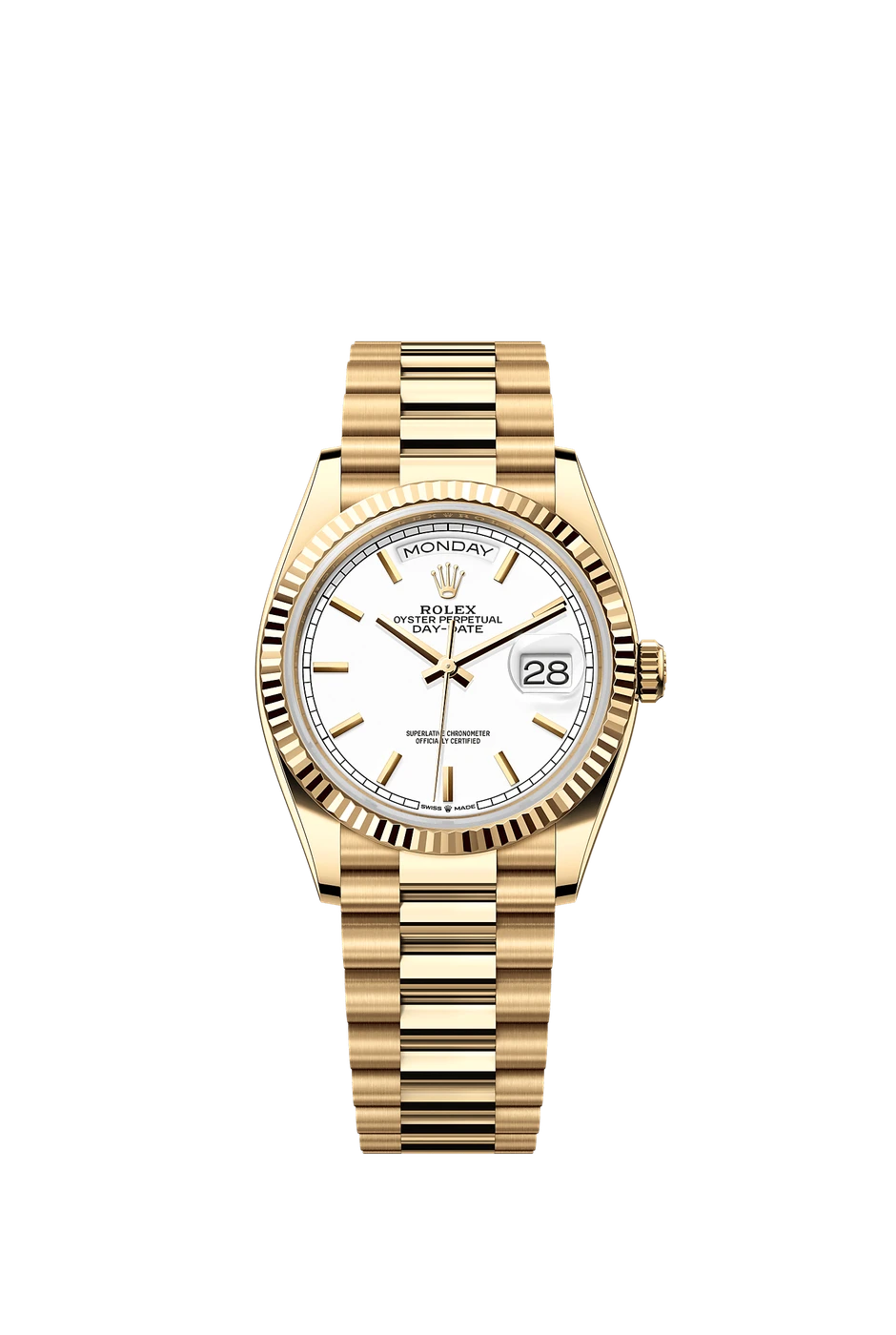
The Day-Date combines a calendar platform with an unusually broad decorative vocabulary. A convincing purchase requires both mechanical identification and an exact account of the dial, metal, case and bracelet.
A Day-Date can be an understated daily watch, an emphatic gold bracelet, a study in mid-century dial design or an extraordinary piece of jewellery. That breadth is its attraction and its principal valuation difficulty. Two watches carrying the same reference can differ radically in desirability because of their dials, bracelet condition and the evidence supporting their configurations.
The President nickname is a useful introduction but an inadequate identification. Begin with the reference and movement, decide which generation and proportions suit you, then investigate the exact decorative execution. The most convincing collection does not need the loudest colour or the highest auction result. It needs a consistent standard for what is genuine, coherent, well preserved and worth paying for.
Design & inheritance
A lineage in time
Day-Date and President
Rolex introduces the Day-Date and its associated three-piece-link President bracelet.[1]
Sapphire and single quick-set
The 18000 generation introduces calibre 3055 and a rapid date adjustment.[16]
Double quick-set
The 18200 generation introduces calibre 3155, with separate rapid adjustment of day and date.[18]
Day-Date II
The 41 mm Day-Date II uses calibre 3156.[25]
Day-Date 40
Rolex introduces the 40 mm generation and calibre 3255.[3]
3255 reaches the 36
The updated Day-Date 36 gains the current movement architecture.[4]
Fluted platinum
Rolex adds a fluted bezel to the platinum Day-Date.[5]
The reference library
Know what you are looking at.
A map of the major reference families covered in this study. Grouped numbers are related variants, not a claim that every dial or material shares identical specifications. Check the complete reference and the individual watch.
17 of 17 reference groups
6511 / 6611 / 6611B
1950sEarly Day-Date architecture and dial signatures; gold configurations documented.
Movement 1055 documented in the cited examples.
1802
1800 generationSmooth-bezel counterpart within the classic 36 mm family.
Movement 1555 / 1556-era family; inspect the actual watch.
1803
Late 1950s–1970sFluted bezel, acrylic crystal and the best-known vintage Day-Date silhouette; multiple gold colours.
Movement 1555 and 1556 examples documented.
1804
1800 generationDiamond-bezel branch documented in gold and platinum.
Movement 1556 documented; verify the individual example.
Do not describe every 1804 as platinum or assume a later diamond bezel establishes factory configuration.
[14]1806 / 1807
1800 generationTextured executions commonly described as Florentine/Tuscan and bark respectively.
Movement 1555 / 1556-era family; individual verification required.
18038 / 18039
Late 1970s–1980sYellow-gold / white-gold sapphire-crystal references respectively.
Movement 3055, single quick-set date.
19018 / 19019
Oysterquartz generationYellow-gold / white-gold Day-Date with angular case and integrated bracelet.
Movement 5055 quartz.
18238 / 18239
1988–around 2000Yellow-gold / white-gold 36 mm references respectively.
Movement 3155, double quick-set.
118238 / 118239
Around 2000–2019 generationYellow-gold / white-gold 36 mm six-digit references.
Movement 3155.
118235
Six-digit 3155 generationPink-gold 36 mm family; later alloy descriptions require dating and verification.
Movement 3155.
An early pink-gold example should not automatically be described as Everose: the cited circa-2000 auction watch is catalogued simply as pink gold.
[21]118206
Six-digit 3155 generationPlatinum 36 mm Day-Date, associated with a smooth bezel.
Movement 3155.
218239 / 218206 — Day-Date II examples
2008–201541 mm white-gold / platinum examples; other precious-metal executions belong to the broader II family.
Movement 3156.
228000 family — Day-Date 40
2015 onwardModern 40 mm platform in precious metals; exact reference specifies metal and decorative execution.
Movement 3255.
228236
Current fluted-platinum generationPlatinum Day-Date 40 with fluted bezel.
Movement 3255.
128238 / 128235
2019 generation onwardYellow-gold / Everose-gold Day-Date 36 respectively; part of the current 128000 family.
Movement 3255.
128236
Current 36 mm platinum generationPlatinum Day-Date 36.
Movement 3255.
Compare full configuration and bracelet fit, not only diameter and metal weight.
[9]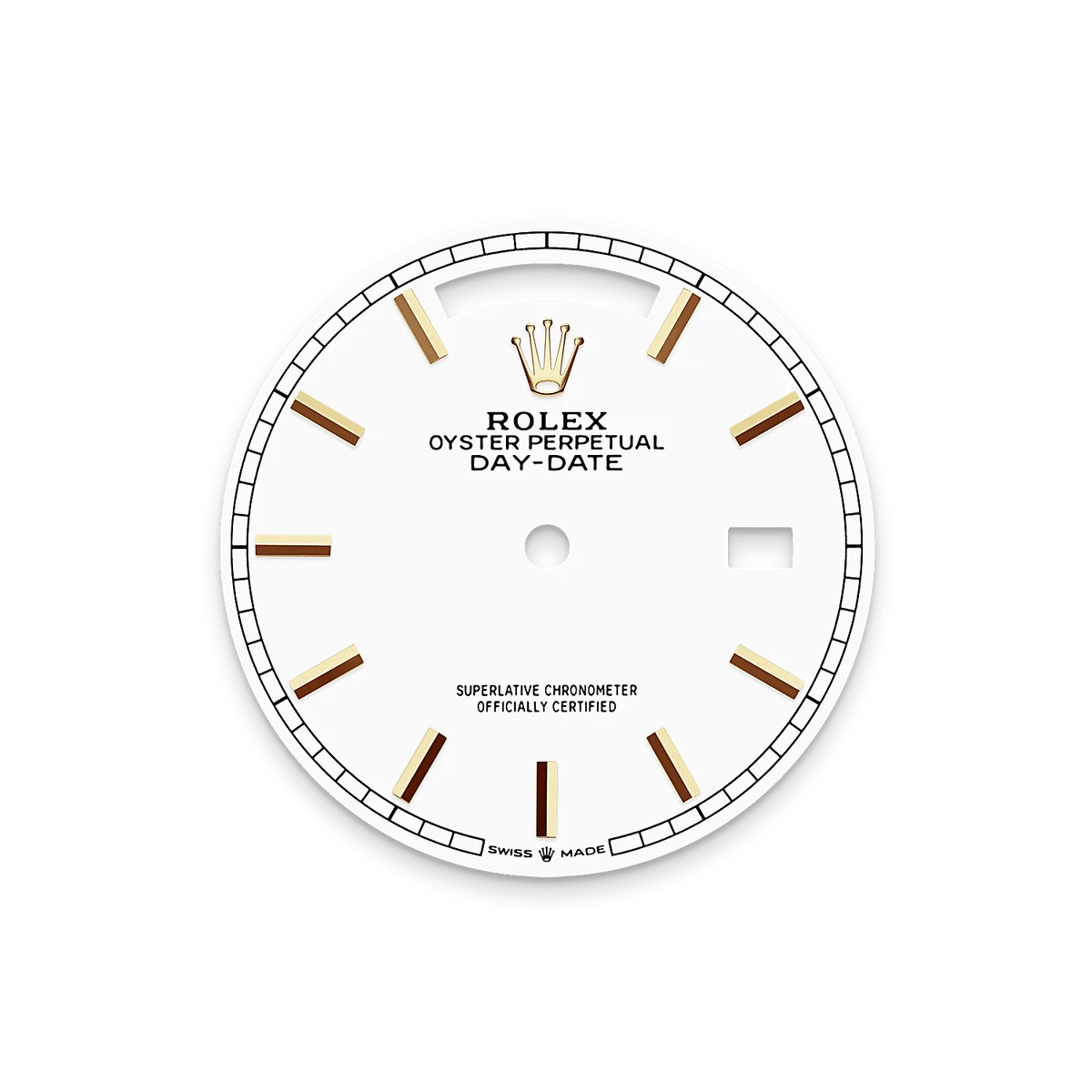
Non-quick-set, single quick-set, double quick-set
The calendar is the first mechanical distinction
The 1803 generation predates the convenient independent quick-setting arrangements of later watches. In the 18038 generation, calibre 3055 brings a rapid date adjustment; it does not independently quick-set the day of the week. Calibre 3155, introduced with the 18200 generation, provides double quick-set functionality. An advertisement that uses quick-set without specifying which indication leaves an important ownership difference unresolved.
The distinction is particularly relevant if a watch will rotate through a collection and regularly stop. Try the setting procedure appropriate to its calibre before deciding whether the vintage experience suits your routine. Do not force the crown or use a generic internet setting instruction for an unidentified movement. Have the seller demonstrate both calendar indications and obtain the correct operating guidance.
An instantaneous calendar transition is also not proof that a movement is healthy. Inspection should cover winding, timekeeping, power reserve and the calendar mechanism together. Ask for a service diagnosis rather than accepting that the watch runs as a complete mechanical condition report.
[16][18][13]36, 41 and 40 mm are different design propositions
The long-standing 36 mm format is not merely a small version of the Day-Date II. The II’s 41 mm case and calibre 3156 belong to the 2008–2015 generation. Day-Date 40 arrived in 2015 with calibre 3255 and different proportions. Try all three formats with properly sized bracelets: bezel width, dial opening, thickness and how the end links sit can matter more than a one-millimetre headline difference.
Regular-production Day-Dates are precious-metal watches. White gold and platinum can look restrained in photographs while feeling different on the wrist; a listing should identify the alloy through markings and documentation rather than colour alone. Equally, pink gold is not automatically Everose. Auction documentation includes early 118235 examples described as pink gold, so a later trade label should not be projected backwards without verification.
Editorial assessment: choose the metal and proportions for actual wear before chasing a dial premium. A beautiful watch that cannot be sized comfortably, or whose presence is wrong for its intended use, is not improved by an unusually appealing reference number.
[25][3][2][21]Stella is lacquer; a colour name is not an attribution
Vintage Day-Date dials range from conventional metallic finishes to the vividly coloured lacquer surfaces collectors call Stella. They should not automatically be described as enamel. Different colours, printing layouts, markers and case metals create distinct configurations; the single word Stella cannot carry the entire valuation argument.
Inspect gloss, surface texture, printing edges, applied markers and the areas around the calendar windows under varied light. A vivid photograph can conceal cracking, spotting, retouching or an uneven finish. Ask whether the colour is faithfully represented and whether the dial has been restored, refinished or replaced. An attractive later dial may still be enjoyable, but it must be priced and described on its actual merits.
Pie-pan describes the shape of a dial’s outer area, not a universal guarantee of age or authenticity. Compare dial form, typography, hands and luminous details with credible examples of the relevant reference and period. A rare colour does not excuse poor evidence for the rest of the watch.
[30][31][13]Natural materials need close inspection, not generic rarity claims
Primary auction records document lapis lazuli and wood dials in the 3055 generation, and meteorite in later platinum references. These are materially different objects. Grain, inclusions and colour variation may be part of a natural surface, while cracks, repairs and material loss are condition issues. Establish which you are seeing instead of treating every irregularity as either damage or a desirable natural signature.
For stone and mother-of-pearl, inspect around the day and date apertures, applied markers and the edge under the bezel. Ask for oblique photographs and a direct condition report; a frontal promotional image is often least helpful for revealing surface problems. The cost and feasibility of an acceptable replacement may be very different from those of a conventional dial.
Factory diamond configurations require their own documentation. Reference 1804 is a documented diamond-bezel branch in both gold and platinum. That does not make a diamond bezel fitted to another reference a factory example. Dial, bezel and case setting should be identified separately, including any later work. A genuine base watch and genuine stones do not by themselves establish an original Rolex jewellery configuration.
[27][28][29][14]The President bracelet is part of the watch’s condition
The President is central to the Day-Date’s identity, but the historical record is more varied than a single bracelet formula. Phillips catalogued an early 6611 on a Jubilee bracelet; Sotheby’s documents a later 118239 with an Oyster bracelet. Such examples demonstrate the need to investigate a particular configuration, not permission to assume any bracelet is correct.
Editorial assessment: examine articulation, lateral play, links, end links, clasp operation, signs of repair and the quantity of usable links. Compare the bracelet’s metal and condition with the case. A short bracelet may create an expensive practical problem even when the watch head is outstanding. Obtain a fit measurement before treating an auction price as a directly comparable complete-watch price.
On the case, inspect lug geometry, hallmarks, fluting and any bark or textured finish. Repeated refinishing can change the design that made the watch appealing. On later models, Rolex’s use of ceramic inserts in President links addresses wear at the joints; it does not remove the need to inspect the actual bracelet or establish what has been replaced.
[12][20][4][13]Oysterquartz deserves its own collecting framework
The 19018 and 19019 are Day-Dates, but their calibre 5055 quartz movement and angular integrated design place them outside the familiar automatic lineage. The yellow-gold and white-gold versions should be evaluated as complete designs, including the bracelet architecture, rather than treated as lesser automatic watches with a different power source.
Editorial assessment: before purchase, establish battery and service history, inspect for leakage or corrosion, and obtain a specialist view of the electronics and movement. Ask who can carry out the required work and what the likely scope is. Case edges, bracelet wear and missing components are equally important: cosmetic and electrical problems do not become trivial because a watch is quartz.
[23][24]Modern Day-Date: architecture, then configuration
The 3255 generation brings the Chronergy escapement and approximately 70 hours of power reserve. It reached the Day-Date 40 in 2015 and the updated Day-Date 36 in 2019. Consequently, a 36 mm case alone cannot tell you whether a watch contains the earlier 3155 or the current movement. The full reference remains essential.
Platinum also needs a generation-specific description. Older smooth-bezel executions are familiar, while Rolex introduced fluted platinum in 2022. The current 228236 combines the 40 mm platform with a platinum fluted bezel; it should not be confused with an older smooth-bezel platinum watch simply because both have an ice-blue dial.
In 2026, Rolex announced Jubilee Gold, a new 18 ct alloy, on the Day-Date 40. Reference 228235JG-0003 combines it with light-green aventurine and baguette diamond markers. Rolex identifies that dial material as natural quartz-family stone, not aventurine glass. This is an important material distinction, but a new alloy or unusual dial is not evidence of a fixed production quantity or guaranteed future premium.
[3][4][5][10][6][7]Provenance must connect to the specific watch
An unusual emblem, language wheel, retailer association or famous owner can be relevant, but each requires a different chain of evidence. A day wheel in a particular language describes a component; it does not, by itself, prove the country of first sale or an uninterrupted ownership history. Distinguish a plausible story from documented correspondence, invoices, photographs or records tied to this watch.
Jack Nicklaus’s 1803 achieved US$1.22 million in a 2019 charity sale. Its documented owner and history are integral to that result. The number is not a price guide for anonymous gold 1803s, even those with similar dials and bracelets. Conversely, an ordinary ownership history does not make a well-preserved, coherent example uninteresting.
Editorial assessment: retain a clear component and service record. Genuine replacement hands, dials or calendar parts may be entirely sensible for use, but they change what can honestly be said about originality. Decide which interventions you will accept before authorising work, and ask for removed parts where possible. A service guarantee and a claim of historical originality answer different questions.
[12][34][35][19]The Day-Date’s prestige role and its collecting opportunities
Rolex presents the Day-Date as a prestige calendar watch, with precious-metal construction and the President bracelet central to its identity. Its collecting logic combines mechanical chronology with jewellery, colour and surface design. The broad appeal of the family therefore does not make every dial or reference equally significant, nor does the gold content explain the whole price.
Editorial assessment: a potential source of lasting interest is the combination of a distinctive, documented configuration and preservation good enough to show why it matters. A modest-looking 1803 can communicate its period more convincingly than an over-restored exotic-dial watch. A 18238 or 118238 may appeal through double-quick-set practicality and a coherent complete bracelet, while an Oysterquartz attracts a different audience through its architecture. These are collecting opportunities to investigate, not assertions that one generation is financially undervalued.
Desirability can weaken when a fashion for a colour passes, repairs undermine the dial, or bracelet replacement changes the economics. New materials such as Jubilee Gold add another chapter but do not establish scarcity. Treat prospective resale as a separate, uncertain calculation, supported by current comparable offers rather than the family’s reputation alone.
[2][18][23][6]Dated evidence, not a live quote
Prices & market context
Each figure belongs to the named reference, source and date. Auction outcomes, retail prices, dealer asks and modelled estimates measure different things. Original currencies are retained; no currency conversion or automatic appreciation is implied.
1803 — Jack Nicklaus’s watch
Phillips, Game Changers, New York · Published total realised including buyer’s premium; charity sale of a watch with exceptional documented personal provenance. Not a representative price for a standard gold 1803.
View source [35] ↗1803 — seafoam Stella dial
Phillips, Geneva Watch Auction XVII, lot 40 · Published Sold For result including buyer’s premium; auction date range. Specific dial and condition matter. Catalogue maximum bracelet length was 150 mm, a material fit consideration.
View source [32] ↗118238 — champagne diamond dial
Bucherer Germany, Rolex Certified Pre-Owned · Live advertised asking price, with VAT included as stated by the seller. A CPO retail listing, not a realised sale or Singapore landed price. Seller’s year attribution is not used here to establish the reference’s introduction date.
View source [36] ↗118238 — opal and diamond dial
Bucherer US, Rolex Certified Pre-Owned · Live advertised price for the specified opal-dial configuration. Its dial and CPO sales channel make it an inappropriate direct comparator for every 118238. Final taxes and charges require confirmation.
View source [37] ↗128238-0069 — green ombré diamond dial
Rolex US official product page · Official US displayed price for this particular diamond-dial configuration, not the white-dial hero watch or an entry price for all Day-Date 36 models. Availability, Singapore pricing and final tax-inclusive cost are separate questions.
View source [8] ↗The evidence above is a set of individual observations, not a market average. Even the two current 118238 listings differ in dial material, currency, country and commercial terms. Their difference does not measure investment performance or establish a premium that every seller can realise.
For a Singapore buyer, obtain a written quotation for the exact watch and its complete bracelet. Add any missing links, likely servicing, insurance and transport. For overseas purchases, compare the actual exchange rate and applicable taxes or import GST within a final landed-cost quote; do not assume a foreign VAT-inclusive or US displayed price translates directly into a Singapore payable amount.
Editorial assessment: compare an executable dealer purchase offer with your acquisition cost to understand the likely immediate spread. A valuable gold bracelet is not a guarantee of narrow resale margins, and a fashionable dial may have a smaller buyer pool than its publicity suggests. Match condition and configuration before using any comparable price.
Editorial assessment
Buy the complete watch, not just the dial
Editorial assessment: a coherent conventional-dial Day-Date with a strong case and correctly fitting bracelet can be a more satisfying acquisition than a compromised rare-dial example. The 18200 and 118000 generations offer a useful double-quick-set collecting framework; earlier references reward deeper historical study, while the 3255 generation offers a different modern ownership proposition. None makes condition or documentation optional.
What sustains the appeal
- A clear mechanical lineage with meaningful calendar improvements.
- Unusually varied materials, dials and decorative techniques within a recognisable design.
- Compelling 36 mm, larger-case and Oysterquartz collecting paths.
What can erode the value
- Dial premiums detached from defensible attribution or surface condition.
- Worn, shortened or heavily restored precious-metal bracelets.
- Treating a provenance record, retail ask or metal value as a universal valuation.
A practical inspection
Before you buy
Establish the generation
Record reference and calibre, then confirm non-quick-set, single quick-set or double quick-set behaviour. Do not let the President nickname replace identification.
Inspect the dial as an object
Check surface, printing, calendar apertures, markers and edges under different lighting. Document repairs, refinishing, replacement and any uncertainty.
Confirm the metal and setting
Inspect hallmarks and the consistency of case, bracelet and clasp. Identify factory and later gem-setting separately; verify alloy descriptions on early pink-gold examples.
Measure the complete bracelet
Obtain its usable length, count removable links and inspect wear and repairs. Price missing components before deciding that an auction or dealer quote is attractive.
Review mechanics and service
Test both calendar indications and obtain a movement assessment. For Oysterquartz, include battery, electronics and corrosion checks by a suitable specialist.
Write down the transaction
Record seller representations, inspection and return terms, currency, fees, taxes and shipping. Keep the acquisition record and obtain a realistic resale comparison.
Collector questions
Is a 18038 double quick-set?
No. Its calibre 3055 quick-sets the date. Calibre 3155 in the later 18238 generation adds independent rapid adjustment of both day and date. Confirm the calibre and operating procedure before using the crown.[16][18]
Is Day-Date II the same as Day-Date 40?
No. Day-Date II is the 41 mm, calibre 3156 generation produced from 2008 to 2015. Day-Date 40 arrived in 2015 with a 40 mm case and calibre 3255.[25][3]
Are Stella dials enamel?
The vintage Day-Date surfaces normally described as Stella are lacquer dials. The nickname is not proof of originality, and vivid colour alone cannot establish a correct period configuration. Inspect the dial itself and its relationship to the watch.[30][31]
Must every Day-Date have a President bracelet?
No. Although closely associated with the model, it is not the only documented configuration. Primary auction records include an early 6611 with a Jubilee bracelet and a later 118239 with an Oyster bracelet. Each individual combination still needs verification.[12][20]
Is Jubilee Gold the same as Everose?
No. Rolex introduced Jubilee Gold as a distinct 18 ct alloy in 2026. The cited 228235JG-0003 Day-Date 40 uses it with a light-green aventurine stone dial. It should not be described as a renamed Everose configuration.[6][7]
Why can two 118238 watches have very different prices?
Dial material, gem setting, originality, condition, bracelet completeness, documentation and the seller’s service proposition all matter. The observed champagne-diamond and opal-diamond CPO listings illustrate different configurations and markets; they do not establish a universal price range or guaranteed resale values.[36][37]
Research notes
Sources & methodology
Researched 25 October 2026. Manufacturer records anchor product history and specifications; auction catalogues describe individual examples. Seller pages and market data retain their stated dates and limitations. Opinions are editorial assessments based on this evidence. Photographs show identified reference examples and do not establish stock availability or our ownership. Singapore Gold Market is independent of Rolex.
Rolex · Accessed 2026-10-25
Rolex Newsroom · Accessed 2026-10-25
Rolex · Accessed 2026-10-25
Rolex · Accessed 2026-10-25 · Day-Date 36 reference 128235 specification within the official 2019 new-models brochure.
Rolex · Accessed 2026-10-25
Rolex Newsroom · Accessed 2026-10-25
Rolex · Accessed 2026-10-25
Rolex · Accessed 2026-10-25 · Green ombré diamond-dial configuration and observed US retail price; not the hero image configuration.
Rolex · Accessed 2026-10-25
Rolex · Accessed 2026-10-25
Phillips · Accessed 2026-10-25 · Auction attribution circa 1955 is distinct from Rolex’s official 1956 launch date.
Phillips · Accessed 2026-10-25
Christie’s · Accessed 2026-10-25
Phillips · Accessed 2026-10-25
Phillips · Accessed 2026-10-25 · Documented historical configurations; not treated as a complete production register.
Christie’s · Accessed 2026-10-25
Christie’s · Accessed 2026-10-25
Phillips · Accessed 2026-10-25
Christie’s · Accessed 2026-10-25
Sotheby’s · Accessed 2026-10-25
Christie’s · Accessed 2026-10-25 · The catalogue calls this early example pink gold; no inference that all examples use the later Everose alloy.
Phillips · Accessed 2026-10-25
Christie’s · Accessed 2026-10-25
Christie’s · Accessed 2026-10-25
Phillips · Accessed 2026-10-25
Phillips · Accessed 2026-10-25
Christie’s · Accessed 2026-10-25
Christie’s · Accessed 2026-10-25
Sotheby’s · Accessed 2026-10-25
Phillips · Accessed 2026-10-25
Phillips · Accessed 2026-10-25
Phillips · Accessed 2026-10-25 · CHF88,900 Sold For; auction held 13–14 May 2023. Catalogue bracelet maximum length 150 mm.
Phillips · Accessed 2026-10-25
Phillips · Accessed 2026-10-25
Phillips · Accessed 2026-10-25 · Official sale result: Nicklaus Day-Date US$1,220,000 including buyer’s premium.
Bucherer · Accessed 2026-10-25 · €33,500 asking price including VAT when opened. Availability and price can change.
Bucherer · Accessed 2026-10-25 · US$55,000 advertised when opened. Availability and price can change.
Discuss the individual watch.
Explore available pieces and customer requests related to this study, or tell us which reference you would like to find. The photographs and market evidence in this article remain reference material.