The collector’s perspective
The Royal Oak is a design language carried by many different watches. Collecting it well means choosing a mechanical and historical branch, then judging the individual case, dial and bracelet with equal seriousness.
The Royal Oak rewards a more precise question than which reference is best. Do you want the thin two-hand-and-date balance of a Jumbo, the visible seconds and stronger presence of a modern automatic, a compact quartz bracelet watch or a calendar that turns the dial into an instrument? Those choices change the proportions, movement, maintenance and historical interest before colour or price enters the conversation.
Gérald Genta’s 1972 design established an unusually coherent relationship between bezel, case, dial and bracelet. The collection subsequently became far broader than that single steel watch. Jacqueline Dimier’s smaller designs, precious-metal interpretations and complicated models are central chapters, not footnotes. A guide restricted to blue-dial steel watches would miss much of what makes Royal Oak collecting interesting.
Our editorial approach is to separate historical importance from suitability. An early 5402 can be a compelling research object without being the easiest daily choice. A 37 mm automatic or a small quartz model can be exactly right without imitating the original mechanically. The most satisfying Royal Oak is one whose proportions you like and whose identity, condition and ownership costs you can explain.
Design & inheritance
A lineage in time
5402 establishes the design
The 39 mm steel Royal Oak debuts at Basel with calibre 2121, a Tapisserie dial and integrated bracelet. AP’s archive records precious-metal 5402 variants from 1977.[1]
The first perpetual calendar
Reference 5554, subsequently numbered 25554, places calibre 2120/2800 within the Royal Oak format. AP distinguishes the Basel announcement from later deliveries.[11]
The reference library
Know what you are looking at.
A map of the major reference families covered in this study. Grouped numbers are related variants, not a claim that every dial or material shares identical specifications. Check the complete reference and the individual watch.
23 of 23 reference groups
5402ST / BA / BC / SA
1972 original; precious metals from 197739 mm Jumbo; steel, yellow gold, white gold and steel/yellow gold.
Movement 2121 automatic, hours, minutes and date
14802 Jubilee / 15002
1992 / 1996Principal 39 mm Jumbo generations between the original and 15202.
Movement 2121 automatic
Treat anniversary execution, material and dial as separate collecting variables.
[2]15202
Introduced 2000; important 2012 dial revision39 mm Jumbo; early and later dial layouts differ.
Movement 2121 automatic
16202 / 16204
Introduced 202239 mm modern Jumbo; date display on 16202, openworked execution on 16204.
Movement 7121 / 7124 respectively
8638, Royal Oak II
Introduced 197629 mm automatic, initially steel; gold and two-tone versions followed.
Movement 2062 automatic
The first smaller Royal Oak was mechanical. Do not assume every small vintage example is quartz.
[4]4100, Royal Oak III
Introduced 197735 mm centre-seconds and date family; multiple materials.
Movement Principally 2123; documented 2125, 2124 and 2506 quartz examples
AP records both original quartz executions and later conversions. Inspect the actual movement and history.
[5]14790
1992–2005 generation36 mm automatic with varied dial and material configurations.
Movement 2125 / 2225 according to generation and example; verify individually
15300 / 15400
Introduced 2005 / 2012Centre-seconds automatic: 39 mm 15300, then 41 mm 15400.
Movement 3120 automatic
15500 / 15510
Introduced 2019 / 202241 mm centre-seconds and date family; 15510 updates the external design.
Movement 4302 automatic
15450 / 15550
2012 generation / introduced 202237 mm automatic alternative to the larger date models.
Movement 3120 / 5900 respectively
77350
34 mm contemporary branchSelfwinding small-format Royal Oak, including a documented black-ceramic execution.
Movement 5800 automatic
34 mm mechanical and 33 mm quartz watches should remain separate search categories.
[18]67600 / 67650
Modern quartz branchThe cited 67600 is a 33 mm steel quartz example; 67650 is officially catalogued as quartz.
Movement 2712 in the cited 67600; consult exact 67650 documentation
67075 / 67076 / 67630 Mini
1997 Mini; new 23 mm generation in 2024Early 20 mm Mini family; 67076 adds a diamond bezel. 67630 returns in Frosted Gold.
Movement 2601 in the early Mini / 2730 in 67630
Miniaturisation and jewellery execution are the collecting subject; modern and vintage service assumptions differ.
[16]25860 / 26300
1997 chronograph launch / subsequent 39 mm generationClassic Royal Oak chronograph branch, distinct from Offshore.
Movement 2385 automatic
26320 / 26331
2012 / 2017 generationsLarger 41 mm chronograph branch, including multiple metals and limited executions.
Movement 2385 automatic
26315 / 26715 / 26240
Modern 38 mm branch; 2022 design generation26315 and 26715 are 38 mm; 26240 is the 41 mm flyback generation.
Movement 2385 documented for 26315; 4401 for 26240; check the exact 26715 specification
5554 / 25554 / 25654
First Royal Oak perpetual calendar in 1984; 25654 from 1987Early 39 mm perpetual-calendar branch.
Movement 2120/2800 family
25820 / 25829
1990s onward39 mm perpetual calendars, with 25829 providing the openworked branch.
Movement 2120/2802 family
Material, dial and openworking create separate comparisons within the same complication.
[12]26574 / 26579CE
2015 generation; black ceramic in 201741 mm perpetual calendars, including the black-ceramic 26579CE.
Movement 5134 automatic
26586 / 26674
2019 ultra-thin production model / 2025 crown-control generationTwo different advances in the perpetual calendar: thin architecture and simplified adjustment.
Movement 5133 / 7138 respectively
25594 / 25920 / 26120
Calendar and travel-time branchesDay-date/moon phase; annual calendar; 39 mm Dual Time respectively.
Movement Reference-specific: 2224/2814 documented for 25920; 2329/2846 for 26120
15407 / 26510 / 26670
Modern openworked and tourbillon branchesDouble Balance Wheel Openworked; tourbillon; extra-thin flying tourbillon.
Movement 3132 / 2924 / 2968 respectively
25865 / 25990 / 26591
High-complication branchesGrande Complication, including perpetual calendar, minute repeater and split-seconds chronograph; separate Supersonnerie minute-repeater branch.
Movement 2885 for the cited Grande Complications; 2953 for 26591
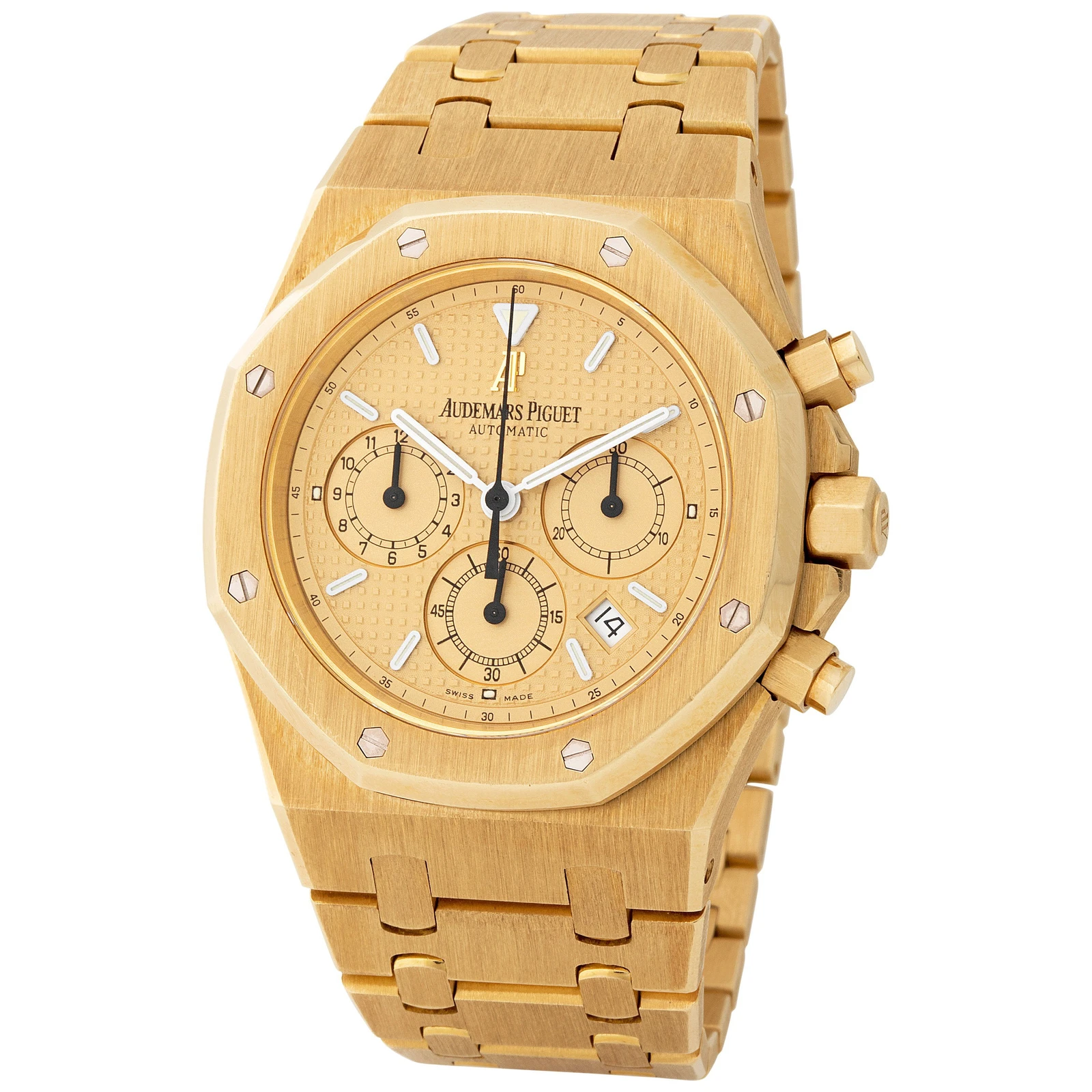
The architecture matters more than the silhouette
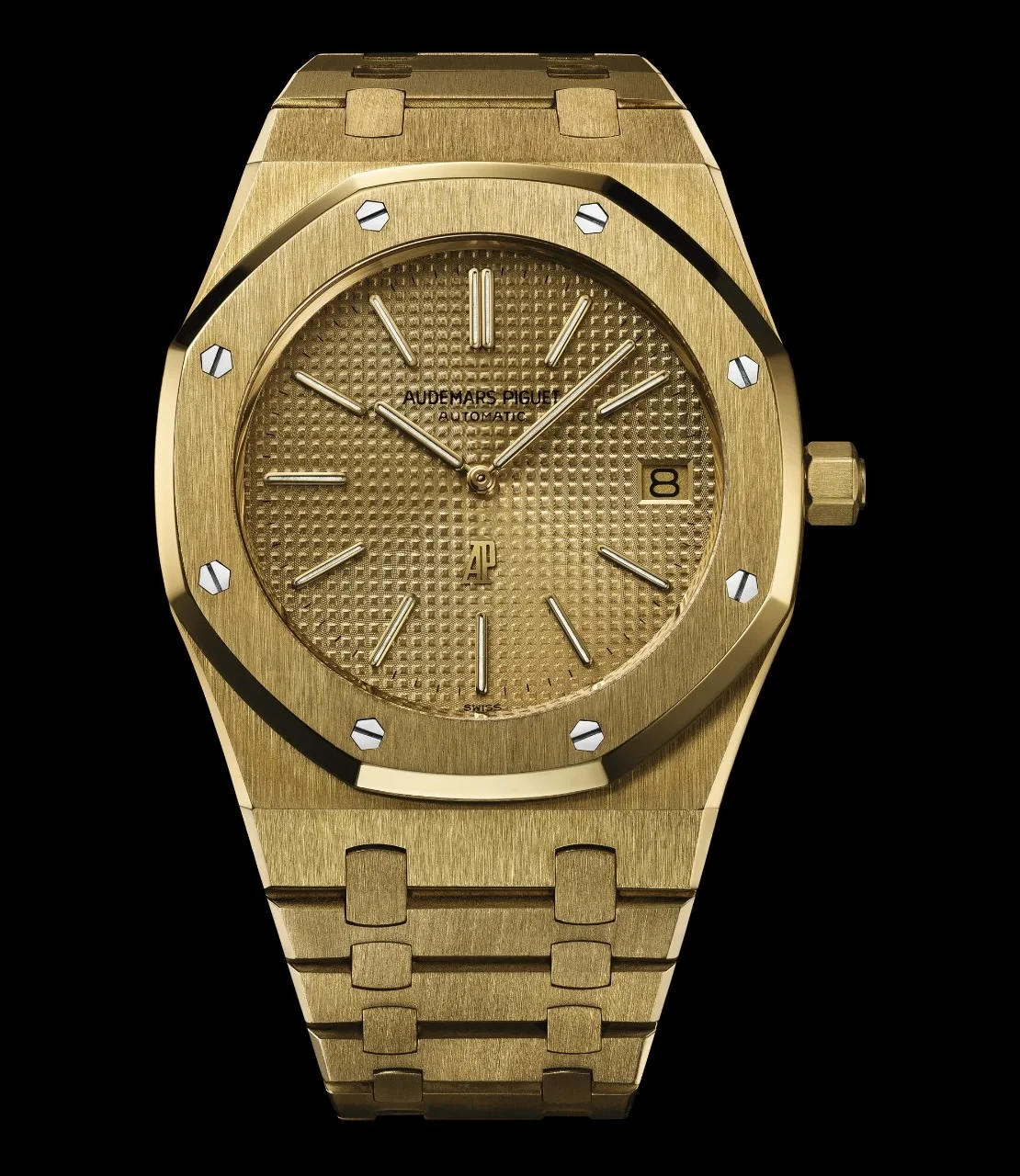
AP’s records describe the original 5402 as a 39 mm monocoque-case watch with calibre 2121 and bracelet 344. Steel was only the starting point: yellow gold, white gold and two-tone versions arrived in 1977. Precious-metal Royal Oaks therefore belong to the design’s early history.
The original bracelet tapers markedly, and AP’s history explains how its first links participate in the case’s visual structure. That makes the bracelet part of the design rather than an accessory. There were also deliberate departures: the 14800 introduced leather in 1992, followed by numerous later strap executions. A strap is not inherently evidence of a modification; the exact reference determines what belongs.
Editorial assessment: examine a Royal Oak as a continuous sequence of surfaces. Bezel planes, case bevels and bracelet links should make visual sense together. A close-up of a pristine dial does not compensate for poorly defined metalwork. Conversely, honest wear can be preferable to an unexplained attempt to restore every surface to showroom brightness.
[1][8]Jumbo and centre-seconds automatics are parallel lineages
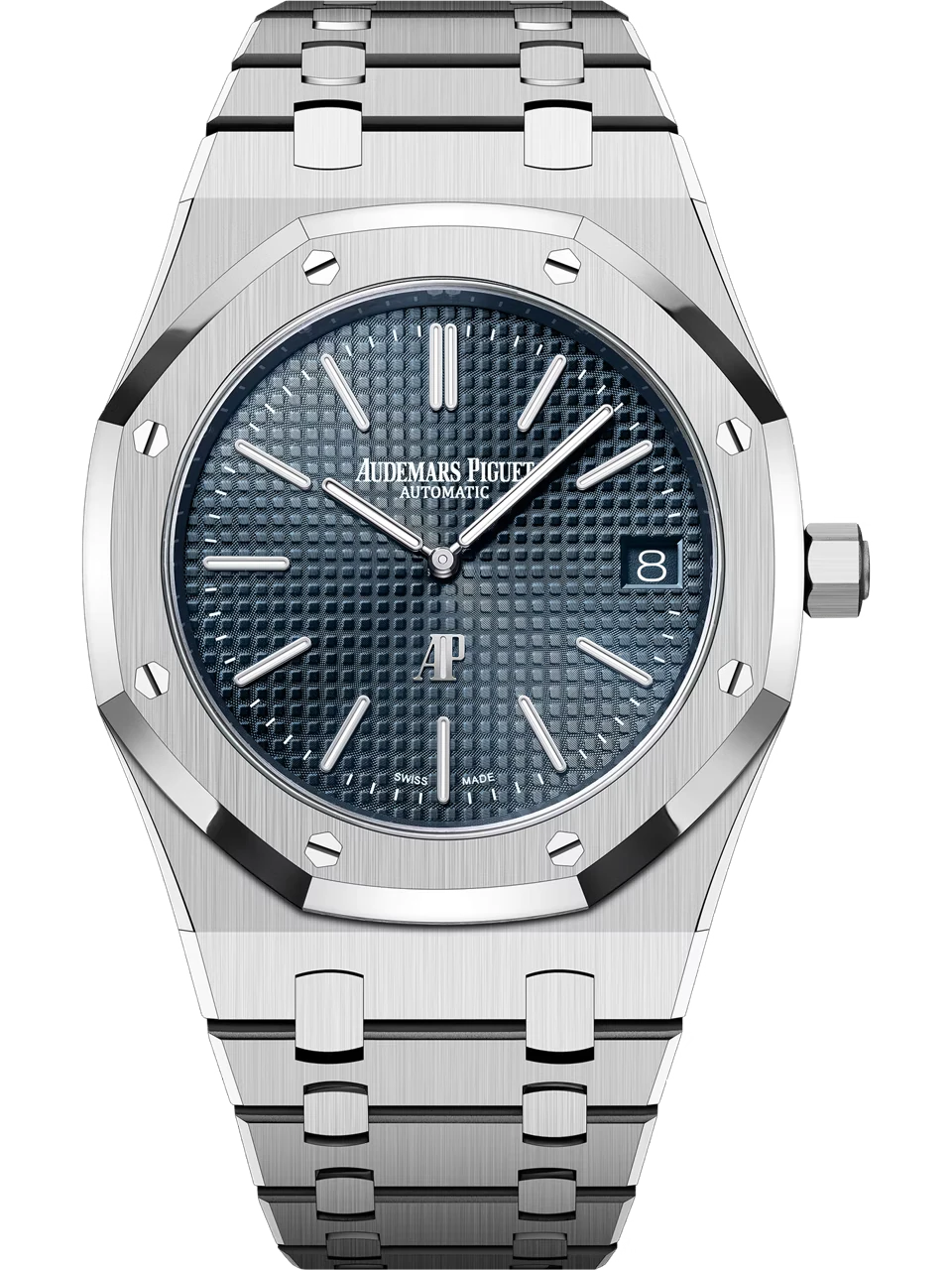
The principal Jumbo succession runs through 5402, 14802, 15002, 15202 and 16202. The meaningful continuity is the thin 39 mm format, not simply a large diameter. A 39 mm 15300 is a different watch: it has centre seconds and calibre 3120. The 41 mm 15400 retains that calibre, while the 15500 introduces 4302; 15510 continues with 4302 and revised external design.
Within the 15202 itself, early and later watches deserve separate attention. The 2012 revision returned the AP logo to the lower dial and revived the Petite Tapisserie treatment. A generic photograph labelled 15202 cannot establish the correct dial for every year. Compare the full reference and documented configuration rather than assuming that the most familiar late version is the only legitimate one.
The 16202’s 2022 change is more than an anniversary rotor. AP replaced 2121 with 7121 and added a fast date-setting system while preserving the extra-thin case concept. The 16204 uses a different openworked calibre, 7124, without a date. Editorial assessment: the older movement’s continuity and the newer movement’s usability are different reasons to buy. Neither requires declaring the other obsolete.
[2][22][24][25][37][7][3]Smaller and quartz Royal Oaks are part of the main story
The 29 mm 8638 arrived in 1976 with a selfwinding movement. Dimier’s 35 mm 4100 followed with centre seconds; AP documents several mechanical calibres and some quartz executions or conversions. Those records defeat two convenient shortcuts: small does not always mean quartz, and one reference does not always guarantee one movement specification across its history.
The modern 37 mm choice also contains a mechanical dividing line. The 15450 uses 3120; the 15550 introduced 5900 in 2022. AP describes the latter as thinner, higher frequency and rated for 60 hours of reserve. The 34 mm 77350 is another mechanical route, whereas references such as 67600 and 67650 occupy the quartz branch. Inspect each watch on its own terms.
The Mini’s 1997 20 mm format returns as a 23 mm Frosted Gold design in 2024, with quartz calibre 2730 in the new 67630. Editorial assessment: scale, bracelet and jewellery character are legitimate collecting priorities. Period gender labels need not determine fit.
[4][5][23][17][18][19][20][16]Choose the complication, then identify its generation
Chronographs require a movement distinction. The classic 25860 and 26300 branch uses 2385; the larger 26331 still uses that movement. The 2022 41 mm 26240 moves to integrated flyback calibre 4401. Do not extend that specification automatically to every 38 mm chronograph pictured beside it. Start, stop and reset behaviour, documentation and service needs must be checked for the actual reference.
Perpetual calendars have their own chronology. The 1984 25554 began the Royal Oak branch; later 25820 and openworked 25829 examples added another chapter. Calibre 5134 brought the complication into a 41 mm format in 2015. The 26586 represents the ultra-thin 5133 approach, while 2025’s 26674 uses 7138 with all calendar adjustments routed through the crown. Easier controls do not remove the need to follow the correct manual.
Openworking, double balance wheels, tourbillons and chiming mechanisms should not be collapsed into a single category called complicated. A 15407 exposes calibre 3132 and its double balance arrangement; a Grande Complication combines several functions requiring their own testing. Editorial assessment: ask what technical feature you want to understand and use. An attractive movement photograph is the beginning of research, not a substitute for a specialist inspection or a service budget.
[26][27][17][11][12][13][9][14][15][30][10]Where Royal Oak ends and its sibling collections begin
The Offshore launched in 1993 with Emmanuel Gueit’s 42 mm 25721. Its enlarged case and chronograph construction created a different wearing experience. AP’s archives even explain why the first examples lack the Offshore word on the caseback. An early engraving should therefore be interpreted with the records, not used alone to reclassify the watch as a classic Royal Oak.
The Royal Oak Concept followed in 2002 as a platform for more experimental construction. It shares a family connection but belongs to a different design and technical discussion. Editorial assessment: keep Offshore and Concept in separate searches and price comparisons. A familiar octagon does not make a large sports chronograph, an experimental tourbillon and an extra-thin Jumbo substitutes for one another.
[31][32]Date the watch with records, not folklore
AP explicitly warns that small case numbers cannot establish an exact sale date. Its archive gives the example of adjacent 5402 numbers sold two years apart. Letter series remain useful research clues, but a table that assigns every A-series watch to one year creates certainty the records do not support. Distinguish manufacture, shipment, retail sale and later service.
Dial originality needs the same care. AP documents the movement of the 5402 logo, changes to the lower dial signature and variation in the Tapisserie pattern. It also describes newly made Classic Parts dials for restoration. An authentic manufacturer replacement and an untouched period dial can both be legitimate objects, but they tell different stories and should not be described interchangeably.
Editorial assessment: request invoices and disclosure of visible component changes. Restoration may suit regular use; preservation may matter more to another collector. Patina and an unpolished claim both require examination of the actual watch.
[6][7]Editorial assessment
Fit, material and total cost complete the decision
Material changes ownership questions. A ceramic perpetual calendar, gold Jumbo and steel centre-seconds watch differ in construction and weight. Ask about damage, replacements and service scope for the exact material; no finish is universally easiest to maintain.
Try the bracelet at an appropriate length; inspect the clasp, articulation and case transitions. Request loose links and confirm replacements can be supplied. Check whether the first links overhang your wrist. Nominal diameter helps build a shortlist but cannot decide comfort.
For a Singapore acquisition, obtain a written SGD total and identify the included watch, accessories, condition disclosures, service commitments and return terms. On overseas purchases, separately check exchange costs, insured delivery and current import/GST obligations. Ask for a realistic purchase or trade-in offer if resale flexibility matters. The gap between that offer and a retail advertisement is more useful than a speculative appreciation percentage.
[1][33][8]Read each price as the result of a specific watch
The 14790 result below belongs to a salmon-dial example, not a generic 36 mm Royal Oak. The 5402 result belongs to a described A-series watch with its own condition and dial history. The 15202 and 26240 represent different generations and functions. Their prices are useful reference points precisely because the objects remain identified alongside them.
Phillips’ Geneva Sessions results sheet states that its published totals include buyer’s premium. Auction sold-for figures should not be confused with hammer bids or a consignor’s net proceeds. The live Perpetual listing is an asking price, not an auction result, and its tax treatment needs reconfirmation for the buyer’s delivery location.
Editorial assessment: retain original currencies until the comparison is defined. A local quotation needs dated conversion and actual costs. Rare dials and special materials change the object being priced; an unusual auction lot cannot establish ordinary-model value.
[34][35][37][36][38][39]Dated evidence, not a live quote
Prices & market context
Each figure belongs to the named reference, source and date. Auction outcomes, retail prices, dealer asks and modelled estimates measure different things. Original currencies are retained; no currency conversion or automatic appreciation is implied.
14790ST, salmon dial, circa 1992
Phillips, New York Sessions Spring 2025, lot 48 · Published sold-for result; box listed and 175 mm bracelet. The unusual salmon dial makes this an unsuitable baseline for every 14790. Catalogue calibre field and essay differ; no mechanical conclusion is drawn from that inconsistency.
View source [34] ↗5402ST A-series, case A1270
Phillips, Geneva Watch Auction XXI, lot 143 · Published sold-for result for a watch recorded as sold in 1974, with a blue dial described as showing copper-toned ageing. This individual example is not a current price for all A-series watches.
View source [35] ↗26240ST.OO.1320ST.04, 50th Anniversary chronograph
Phillips, Geneva Watch Auction XXI, lot 106 · Published sold-for result for the identified anniversary execution; compare exact dial, condition and included accessories. Do not equate it with a 2385-powered chronograph.
View source [36] ↗15202ST, circa 2020
Phillips, Geneva Sessions Fall 2025, lot 4 · Result includes buyer’s premium, as specified by the sale’s published results sheet. Box and warranty card listed; bracelet maximum 195 mm. Delivery and applicable taxes remain transaction-specific.
View source [37] ↗15407ST.OO.1220ST.01, Double Balance Wheel Openworked, 2017
Phillips Perpetual, London listing · Live listing observed on this date, not a realised sale or listing creation date. Warranty booklet and inner/outer boxes listed. The displayed Ω notation is associated with VAT treatment; confirm the tax-inclusive amount and availability with the seller.
View source [39] ↗15510ST, steel Selfwinding base model across dial variations
WatchCharts, 15510ST base-model overview · Provider’s estimated private-sale price as of 24 October 2026, observed 25 October with Global (USD) selected. It is a model-level estimate, not an individual transaction, dealer quotation or guaranteed resale value. Match dial variation, condition and completeness before comparison.
View source [40] ↗Editorial assessment: Royal Oak is too broad a label for a single investment thesis. The historical Jumbo, modern centre-seconds, chronograph, small quartz and high-complication markets should be analysed separately.
The WatchCharts figure adds an ordinary steel-model estimate to the identified auction results and dealer advertisement. These are different evidence types, not interchangeable transaction prices or a return series. Condition, dial, material and completeness still govern the comparison.
Obtain a condition-specific service assessment and compare complete acquisition costs with local alternatives. Understanding the configuration, fit and maintenance needs is a stronger basis for purchase than reputation alone.
Editorial assessment
Brand position and collecting potential: choose a meaningful generation
Editorial assessment: Royal Oak connects Audemars Piguet’s design identity with its calendar, openworked and chiming traditions. It is more than the steel watch most visibly associated with the brand. Gold references belong to its early history; smaller mechanical and quartz models broaden the idea; complicated versions use the same architectural language for very different technical ambitions. That breadth is a collecting advantage only when the buyer understands the chosen branch.
Concrete opportunities are differences of experience, not predictions of appreciation. A 14790 offers compact vintage proportions; a 15450 or 15550 gives a 37 mm alternative with distinct movements. A 15202 preserves the 2121 lineage, while a 16202 offers the newer 7121 and faster date setting. Compare those qualities against condition and total cost rather than calling an older or less publicised generation automatically undervalued.
Desirability is supported by coherent case geometry, an appropriate dial, a complete bracelet and an intelligible service history. Aggressive refinishing, undisclosed replacement parts and expensive unresolved mechanical work can weaken the proposition. AP’s archival depth helps research, but does not make every offered watch original. Collecting value comes from a defensible object and a clear purpose, not steel-market excitement.
What sustains the appeal
- An unusually coherent relationship between case, dial and bracelet
- Deep official archival material for historical research
- Substantial mechanical and aesthetic variety across sizes and complications
What can erode the value
- Reference names can conceal different movements, dials and generations
- Refinishing or component changes can complicate historical interpretation
- Special-provenance and rare-dial prices can distort ordinary comparisons
A practical inspection
Before you buy
Choose the lineage
Write down the full reference and calibre. Separate Jumbo, centre-seconds, quartz, chronograph and calendar branches before comparing offers.
Assess the metalwork
Request clear photographs of bezel planes, case bevels, bracelet edges, clasp and back. Ask exactly what refinishing or restoration has been performed.
Explain the dial
Check the pattern, logo, signatures and hands against the documented configuration. Ask whether any part is a service replacement or later addition.
Date with records
Reconcile case and movement numbers with archive and service information. Do not use a serial-letter rule as an exact production date.
Test fit and functions
Confirm bracelet length and loose links. Have a qualified specialist inspect the movement and demonstrate relevant calendar or chronograph functions.
Price the whole purchase
Confirm final SGD cost, documented condition, service scope, delivery and written terms. Keep an overseas asking price separate from landed cost and local resale expectations.
Collector questions
Is every 39 mm Royal Oak a Jumbo?
No. The classic Jumbo lineage centres on the thin 5402, 14802, 15002, 15202 and 16202 succession. The 39 mm 15300 has centre seconds and calibre 3120; sharing a diameter does not make it mechanically equivalent.[2][8]
What changed between the 15202 and 16202?
The 16202 introduced calibre 7121 in 2022 in place of 2121, including fast date setting while retaining the extra-thin Jumbo concept. A comparison should include movement behaviour and the precise dial/material configuration, not only appearance.[3]
Are small Royal Oaks always quartz?
No. The 29 mm 8638 was selfwinding, and modern 34 mm and 37 mm families also include automatic models. Quartz is a separate, historically significant branch, including the Mini. Verify the reference and movement of the actual watch.[4][18][17][16]
Can the A, B, C or D number precisely date a 5402?
No. AP’s archival research says those small numbers can suggest a period but cannot establish an exact sale date because watches were not distributed in numerical order. Use the watch and archive information together.[6]
Research notes
Sources & methodology
Researched 25 October 2026. Manufacturer records anchor product history and specifications; auction catalogues describe individual examples. Seller pages and market data retain their stated dates and limitations. Opinions are editorial assessments based on this evidence. Photographs show identified reference examples and do not establish stock availability or our ownership. Singapore Gold Market is independent of Audemars Piguet.
Audemars Piguet, AP Chronicles · Accessed 2026-10-25
Audemars Piguet, AP Chronicles · Accessed 2026-10-25
Audemars Piguet · Accessed 2026-10-25
Audemars Piguet, AP Chronicles · Accessed 2026-10-25
Audemars Piguet, AP Chronicles · Accessed 2026-10-25
Audemars Piguet, AP Chronicles · Accessed 2026-10-25
Audemars Piguet, AP Chronicles · Accessed 2026-10-25 · Hero photograph source; also documents historical dial changes and restoration dials.
Audemars Piguet, AP Chronicles · Accessed 2026-10-25
Audemars Piguet, AP Chronicles · Accessed 2026-10-25
Audemars Piguet, AP Chronicles · Accessed 2026-10-25 · Historical complication overview. Individual captions and corroborating lot descriptions take precedence over obvious reference-number typographical errors in narrative text.
Audemars Piguet, AP Chronicles · Accessed 2026-10-25
Audemars Piguet, AP Chronicles · Accessed 2026-10-25
Audemars Piguet · Accessed 2026-10-25
Audemars Piguet · Accessed 2026-10-25
Audemars Piguet · Accessed 2026-10-25
Audemars Piguet, AP Chronicles · Accessed 2026-10-25
Audemars Piguet · Accessed 2026-10-25
Audemars Piguet · Accessed 2026-10-25
Phillips · Accessed 2026-10-25 · 33 mm quartz calibre 2712 example.
Audemars Piguet · Accessed 2026-10-25
Phillips · Accessed 2026-10-25 · Reference production history and documented calibre 2225 example; the rare yellow-dial result is not used as a standard market price.
Christie’s · Accessed 2026-10-25
Christie’s · Accessed 2026-10-25
Phillips · Accessed 2026-10-25
Phillips · Accessed 2026-10-25 · 41 mm calibre 4302 and 2022 anniversary execution.
Phillips · Accessed 2026-10-25 · Used for the documented 39 mm calibre 2385 example, not its conflicting launch-date wording.
Phillips · Accessed 2026-10-25
Phillips Perpetual · Accessed 2026-10-25 · Sold listing used for specifications only, not current price.
Christie’s · Accessed 2026-10-25
Phillips · Accessed 2026-10-25
Audemars Piguet, AP Chronicles · Accessed 2026-10-25
Musée Atelier Audemars Piguet · Accessed 2026-10-25
Audemars Piguet · Accessed 2026-10-25
Phillips · Accessed 2026-10-25 · 1 April 2025; USD 48,260. Catalogue lists 2125 in the details and 2225 in its essay; the inconsistency is disclosed.
Phillips · Accessed 2026-10-25 · 11 May 2025, session II; CHF 76,200 published result. Historical family claims are checked against AP Chronicles.
Phillips · Accessed 2026-10-25 · 11 May 2025, session II; CHF 60,960 published result.
Phillips · Accessed 2026-10-25 · 12 September 2025; CHF 44,450 published result.
Phillips · Accessed 2026-10-25 · Confirms sale date and that results include buyer’s premium.
Phillips Perpetual · Accessed 2026-10-25 · GBP 119,500 asking price observed. A listing, not a completed transaction; confirm tax treatment and availability.
WatchCharts · Accessed 2026-10-25 · Primary provider page displayed USD 46,968, estimated private-sale price, as of 24 October 2026; global currency selector showed USD. This is an estimate rather than a realised transaction.
Discuss the individual watch.
Explore available pieces and customer requests related to this study, or tell us which reference you would like to find. The photographs and market evidence in this article remain reference material.